
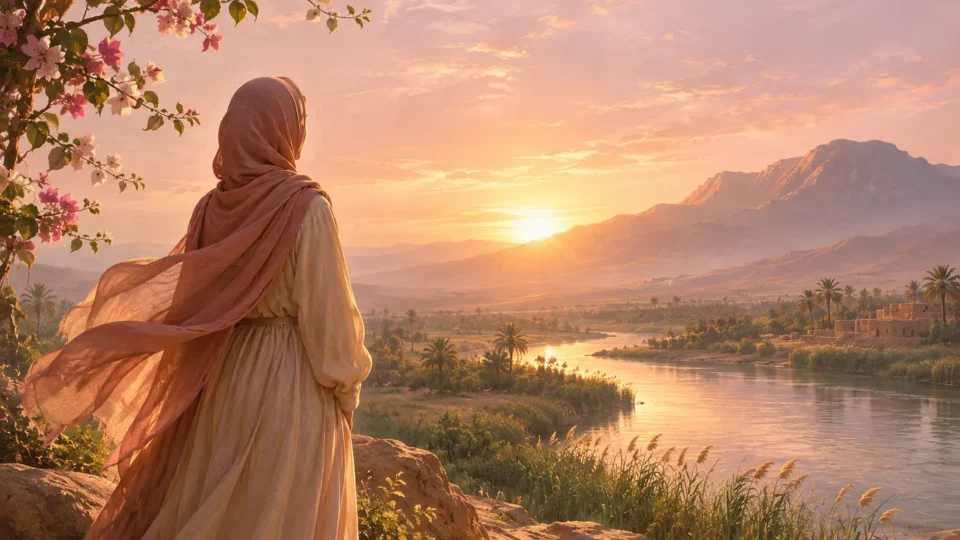
On the quiet, unexpected beauty of becoming.
There is a woman I have not yet met.
I have been thinking about her lately. Not with apprehension, as one might expect, but with a curiosity that surprises even me. I catch glimpses of her in the quiet of the morning, when the world has not yet begun to make its demands of me. Sometimes, she appears in the middle of a conversation about business, or while I am reading a passage of the Qur’an, or when an idea for something I want to write suddenly takes shape in my mind.
She is familiar, and yet she is not quite the woman I have known all these years.
I think Allah is introducing me to her, slowly.
For much of my adult life, my identity was woven into the life I shared with my husband. I was a wife, a mother, a companion, a partner in the ordinary and extraordinary business of living. Over the years, I had also become many other things. A lawyer, a scholar, a businesswoman. But somehow, those identities existed alongside a more deeply rooted understanding of myself: I was his wife.
And then, quite suddenly, I wasn’t.
There is something profoundly disorienting about the disappearance of an identity you have inhabited for so long. The familiar language of your life changes. The we becomes I. The future, which had always been imagined with another person in it, becomes an open landscape.
And yet, what has surprised me most is not the uncertainty of that landscape.
It is the possibility.
I find myself looking towards the years ahead with an unexpected sense of anticipation. Not because I have ceased to love the life I had, nor because I imagine the road ahead will be easy. But because, somewhere beneath the unfamiliarity of this new existence, I feel something stirring. A part of me that has perhaps been waiting, quietly and patiently, for its appointed season.
We tend to imagine that identity is something we establish in the earlier chapters of life. We study, we marry, we raise our children, we build our careers. Somewhere along the way, we assume that the essential work of becoming has been completed.
But perhaps we are never finished.
Lately, I have found myself returning to a passage in Sūrah Ṭā Hā that I have always loved, but which now speaks to me in an entirely different way.
It is the moment when Mūsā stands in the sacred valley, in the presence of his Lord. Allah has called him, chosen him, and is about to entrust him with an extraordinary responsibility.
But before sending him forward, Allah takes him back.
He reminds Mūsā of his beginnings. Of the mother who, fearing for her infant son, placed him in a small chest and entrusted him to the river. Of how that child was carried into the very household of Pharaoh, the man who would become his greatest adversary.
And then come the words I find almost unbearably tender:
Wa alqaytu ʿalayka maḥabbatan minnī.
“And I cast upon you love from Me.” (20:39)
Allah had bestowed upon this child a love that would make him cherished, even in the household of an enemy. He had been watched over, protected and nurtured, long before he could have understood what was happening to him.
Allah then recounts the unfolding of his life. His reunion with his mother. The trials of his youth. His departure from Egypt. The years spent in Madyan.
And then, having gathered those seemingly disconnected chapters into a single narrative, Allah says:
Thumma jiʾta ʿalā qadarin yā Mūsā.
“Then you came at the appointed time, O Mūsā.” (20:40)
And in the following verse:
Waṣṭanaʿtuka linafsī.
“And I fashioned you for Myself.” (20:41)
I find something extraordinarily beautiful in this.
What Mūsā might have experienced as uncertainty, displacement, danger and wandering is now revealed to him as part of a divine preparation. The child upon the river could not have known the man he was being prepared to become. Nor could the young shepherd in Madyan have fully understood that his years of obscurity were leading him towards an encounter that would transform his life.
Only when he arrived at the appointed moment was the larger meaning of his journey disclosed to him.
I would never presume to know the hidden wisdom behind the events of my own life. But this passage has made me look differently upon the years I have already lived.
What if the experiences I thought were merely chapters of my past have also been preparing me for responsibilities I have yet to assume?
Perhaps the woman I have yet to become has been forming all along.
The Qur’an offers an understanding of the human being that I have long found deeply compelling. We are beings entrusted with amānah, a moral responsibility that gives weight and meaning to our existence. Our presence in this world carries an obligation to cultivate, to nurture, to exercise judgement, and to leave something of goodness behind.
I have spent years contemplating these ideas as a scholar. But I am beginning to understand that there is a difference between studying a truth and being called upon to live it.
For perhaps the question is not simply, Who am I?
But Who am I being asked to become?
I think about the writer in me, who has so much still to say. For years, I wrote within the careful architecture of academic thought, searching for meaning in texts, traditions and the great philosophical questions of human existence. Now I find myself wanting to write from another place altogether. A place where scholarship meets experience, where the intellect is no longer afraid to speak in the language of the heart.
I think about the scholar in me, who is discovering that knowledge is not merely something to acquire, but something that must eventually transform the person who possesses it. What good is a lifetime spent studying the human being if one remains a stranger to oneself?
I think about the matriarch I am becoming. My children are grown now, and the nature of my responsibility towards them is changing. Perhaps I am being called to become something else for them. An anchor. A place of wisdom and steadiness. Someone whose presence reminds them not merely of where they come from, but of the values by which they might choose to live.
And then there is the businesswoman. The part of me that has spent years helping to build dreams, and must now learn to carry some of them forward with a different kind of courage. There are decisions to make, people who depend upon me, and responsibilities that cannot be deferred. I have moments when the enormity of it all unsettles me. But there are also moments when I discover a quiet resolve I did not know I possessed.
None of these women is entirely new.
They have all been here, in one form or another. But perhaps I am only now beginning to understand what they might become.
There is, of course, a certain vulnerability in this. I do not know whether I will succeed in everything I hope to undertake. There will be days of doubt, decisions I may regret, and moments when I will long for the familiarity of a life in which I did not have to carry so much on my own.
But becoming does not require certainty.
Perhaps it requires only the willingness to remain open to what Allah is unfolding within us.
And so I am learning to look upon this new chapter of my life differently.
Widowhood is now part of my story. It is a reality I carry with tenderness and with all the dignity I can summon. But I do not wish for it to become the entirety of who I am. It is a threshold I have crossed, not the destination at which my life has arrived.
There is still work to be done. There are books I want to write, ideas I want to pursue, institutions I hope to strengthen, and children whose futures I want to help illuminate. There is wisdom I have yet to acquire, goodness I have yet to contribute, and, I suspect, much about myself that I have yet to understand.
At this season of my life, I had not expected to feel the quiet excitement of a beginning.
Yet here it is.
Not the excitement of someone who believes she can conquer the world. I have lived long enough to know how fragile our plans are, and how little of tomorrow truly belongs to us.
It is something gentler than ambition. Something closer to awakening.
I do not know what this woman will look like in five years, or ten. But I hope she will be wise without becoming hardened. Strong without losing her tenderness. Independent without forgetting her need for Allah. I hope she will have the courage to speak when something needs to be said, the humility to remain silent when it does not, and the generosity to make room for others to flourish.
Above all, I hope she will understand that becoming is not an exercise in self-invention, but a lifelong act of answering the trust placed within us.
And perhaps, one day, I will look back upon this season and recognise it for what it was.
Not the moment my life became smaller.
But the moment I began to understand how much of it was still waiting to unfold.
There is a woman I have not yet met.
And for the first time in a long while, I find myself looking forward to meeting her.
About the Author
Dr Hidayah Wan Ismail
Read more of her writings on Medium.
Originally published on Medium, 18 November 2026. Republished with permission.
